Seeing an object is only the beginning.
How detection outputs become a grasping decision. Read the mechanism on its original drawing.
An independent reading of Siemens publication US20240198530A1. This example examines one disclosed embodiment.
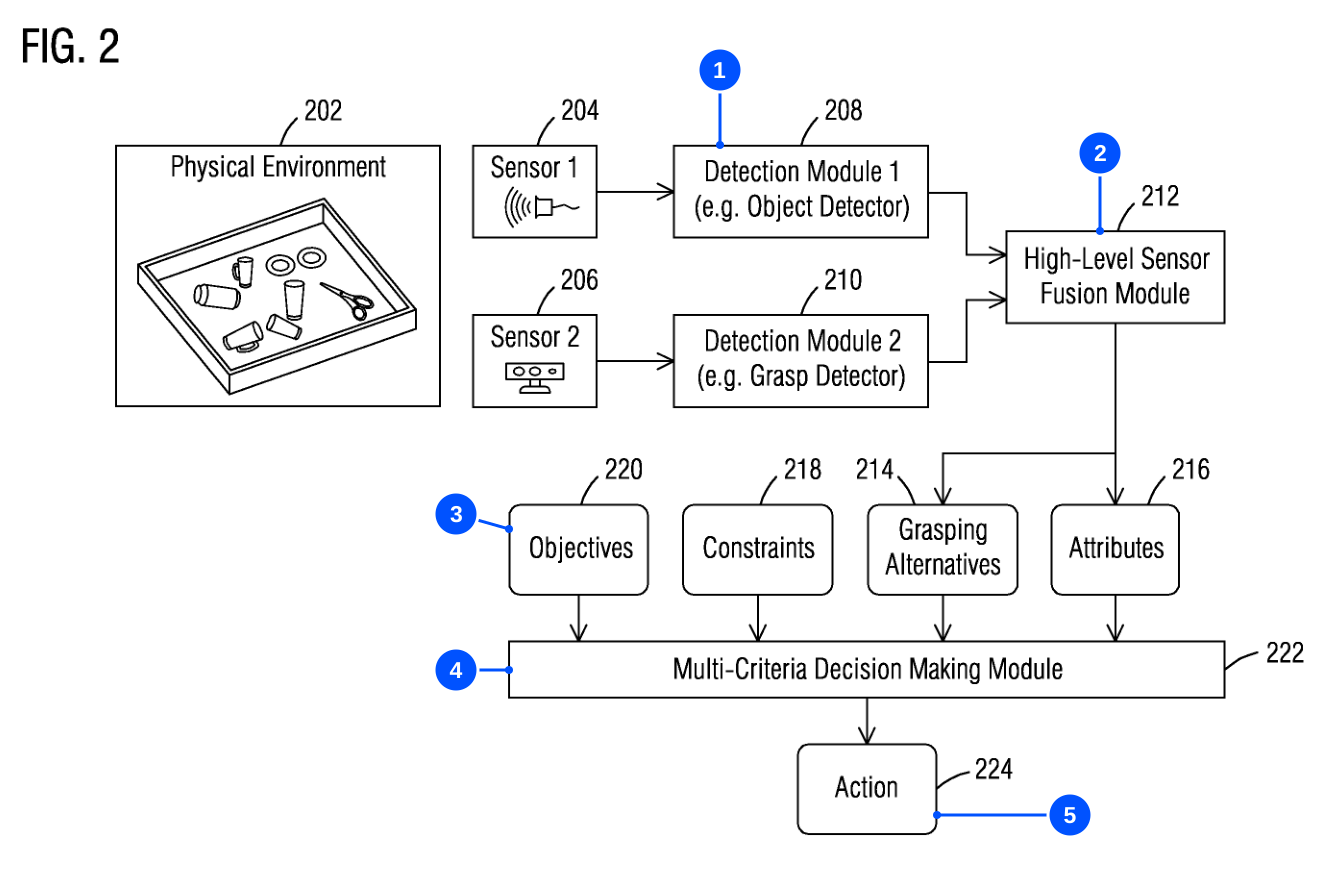
Rotated upright; the patent’s geometry, arrows and reference labels are preserved. Blue leaders identify parts; they do not add process connections.
- 208 / 210 · Detection modules
Find objects and possible grasps.
The example object detector locates objects of interest; the grasp detector supplies candidate grasp locations. The description also allows both inputs to come from one sensor.
Description [0027] · page 8 - 212 · High-level sensor fusion
Relate the outputs.
The fusion module combines detection outputs and computes attributes for the alternatives, including relationships between candidate grasps and detected objects.
Description [0027] · page 8 - 220 / 218 · Objectives and constraints
Specify what matters.
The ranking can reflect which objects to pick and constraints imposed by the environment. In the described embodiments these can be predefined or supplied by a user.
Description [0027] · page 8 - 222 · Multi-criteria decision making
Rank the alternatives.
Each criterion in the described decision matrix has a weight. A candidate is evaluated across those criteria before a grasp is selected. The patent gives several possible decision methods.
Description [0045] · page 10 - 224 · Action
Turn the selection into instructions.
The selected alternative defines the output action. Executable code can then be sent to the robot controller to carry out the selective grasp.
Description [0047] · page 11
Detection supplies possibilities.
Criteria guide the choice.
The disclosed system separates detection from the choice of action. It combines what the detectors report, attaches attributes to candidate grasps, then ranks the alternatives using the application's objectives and constraints. That distinction makes the decision criteria visible rather than treating a predicted grasp score as the whole decision.
What changes after an attempt?
Paragraph [0048] describes an optional way to adjust criterion weights using simulation or real-world results, within ranges initially defined by an expert. Improved settings can become the starting point for the next optimization step. This is a specified tuning procedure, not evidence of unrestricted learning or guaranteed safe performance.
Inspect paragraph [0048] · original page 11One disclosed embodiment. The drawing and description establish what is proposed; they do not establish deployment, measured picking performance or a safety guarantee.
Bring a patent.
Follow what matters.
Start from this example, change the publication or question, then review your reading plan and price before generation begins.